Distinguishing wild-caught from farmed fish is a frequent concern among seafood consumers who want to know what they are eating. Although experienced fishers and marine experts can sometimes infer a fish’s origin, reliably telling wild fish apart from farmed ones remains challenging for most consumers.
As of this year, EU regulations mandate the use of digital systems for full electronic traceability of seafood products, further increasing the need to verify the true origin of fish. At the same time, differentiating between wild and farmed fish has become increasingly important because farm escape events and inaccurate stock assessments can have serious ecological and economic consequences.
In response to these challenges, body-shape analysis supported by artificial intelligence offers a fast, non-invasive, and efficient tool for distinguishing wild from farmed fish. Recent advances show that computer-based analysis can measure fish morphology more precisely, consistently, and reliably than the human eye, opening a new chapter in aquaculture monitoring.
Within the framework of the EpoMariNet project, funded by the Croatian Science Foundation, our aquaculture laboratory has been developing a robust, objective, and automated approach to “reading” fish body shape, enabling clear and measurable discrimination between farmed and wild individuals. This is crucial for detecting escapees from fish farms, protecting wild populations, and preventing fraud in fish labeling and marketing.
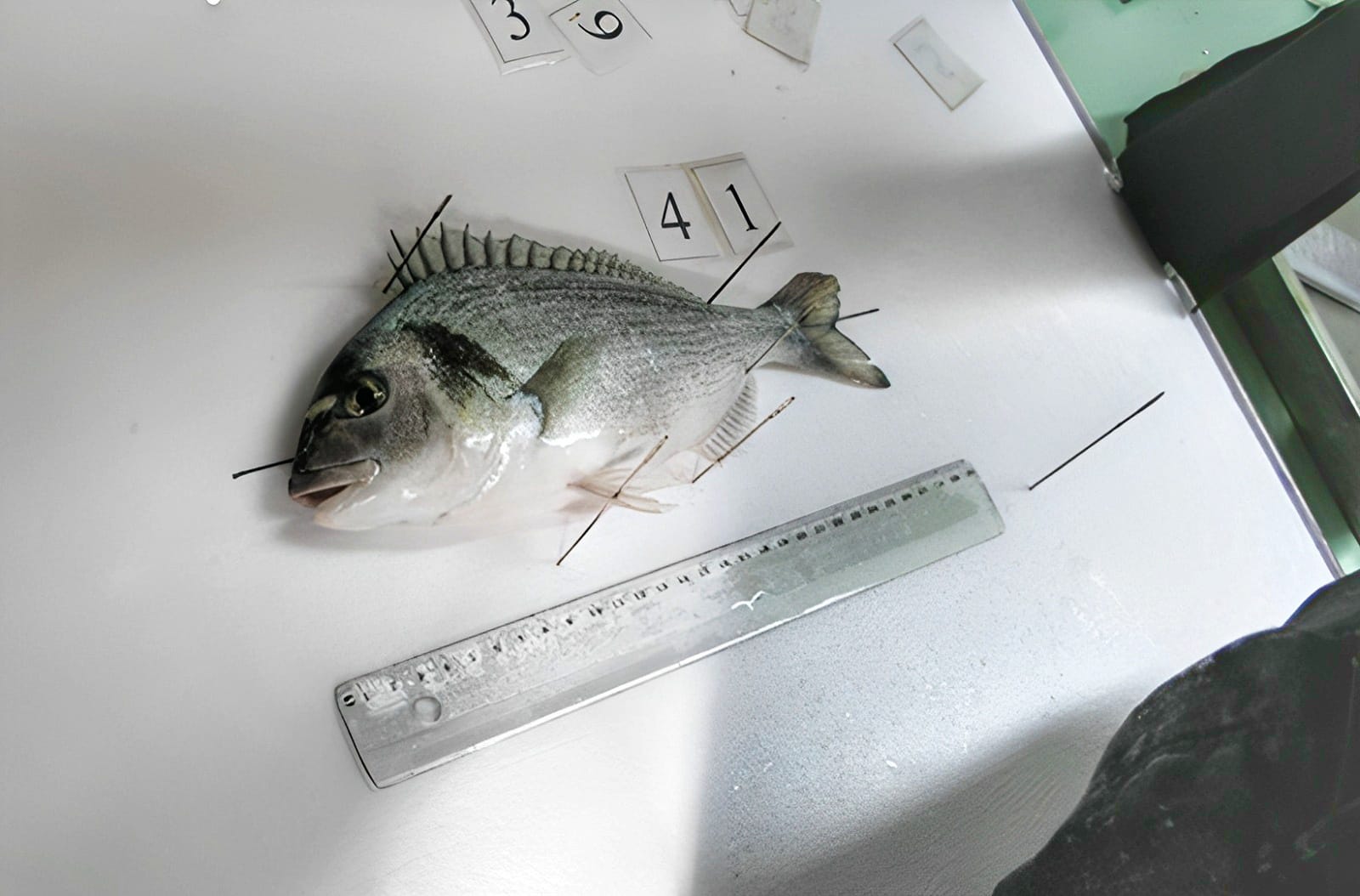
To effectively train artificial intelligence for applications in geometric morphometrics, researchers collected and manually landmarked more than two thousand photographs of gilthead seabream. These data were then used to train a model to automatically detect key anatomical landmarks, while carefully assessing whether the model distinguishes true biological differences from errors introduced by image acquisition and human subjectivity.
A particular challenge was posed by the cage-associated morphotype of gilthead seabream, whose body shape is subtly shaped by environmental conditions and morphologically very similar to that of wild individuals, making origin discrimination especially difficult.
The outcome of this work is a study published in the international scientific journal Ecological Informatics, in which our researchers, in collaboration with the Faculty of Electrical Engineering and Computing (FER) and the University of Ljubljana, developed a reliable and transparent method for automated classification of gilthead seabream origin, significantly reducing human-induced error and enabling scalable monitoring of aquaculture escape events.