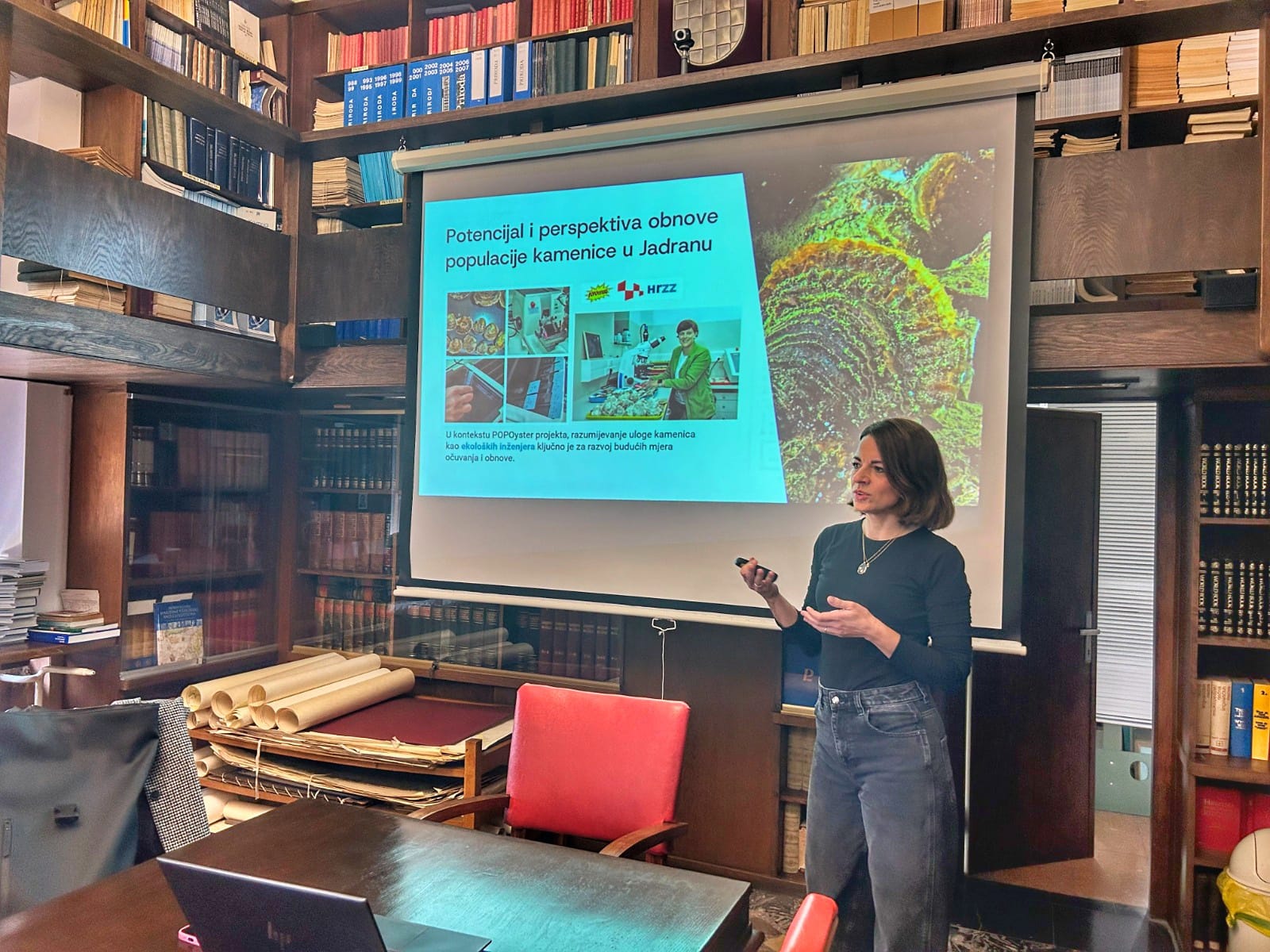
Today, as human interventions in natural systems become more frequent, it is increasingly clear that such actions are sometimes unavoidable, but can still be designed in ways that work with nature rather than against it. This was the focus of a lecture delivered by Dr. Ivana Prusina Conde at the Institute of Oceanography and Fisheries, where she presented the principles and applications of Nature-Based Solutions.
Through an overview of core concepts and examples of good practice, the lecture highlighted how responsible, well-planned interventions can simultaneously support human needs and contribute to ecosystem conservation. A particular emphasis was placed on the restoration of the European flat oyster (Ostrea edulis), a species of significant ecological and economic importance.
The lecture was held as part of the Croatian Science Foundation project POPOyster – Potential and Perspective of Native Oyster Restoration in the Adriatic Sea, led by Dr. Daria Ezgeta Balić. Within the project, researchers are examining the current status of oysters in the Adriatic, their distribution in deeper areas of the northern Adriatic, reproductive cycle and larval dynamics. The next phase includes testing different settlement materials, identifying suitable sites for juvenile oyster recruitment and implementing restoration actions.
This approach represents an important step toward sustainable management of coastal ecosystems, demonstrating how innovative nature-based solutions can support the recovery of key marine species and strengthen the long-term resilience of the Adriatic Sea.