Today we know that a large number of fish species produce sounds, and that both the reasons for sound production and the mechanisms involved can vary considerably among species. Fish use sound during reproduction, in defence against predators, and in territorial behaviour. Sounds can be produced by vibrating the swim bladder, grinding teeth, rubbing different bony structures, or through body movements.
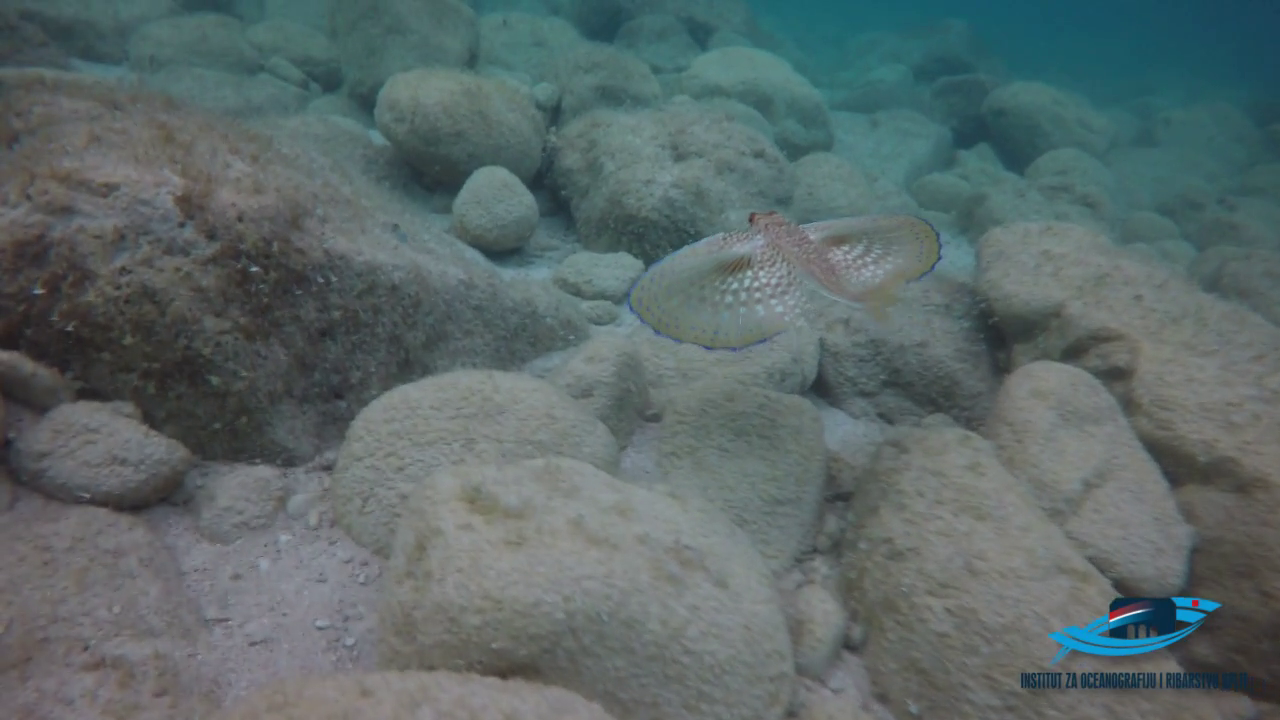
During underwater fieldwork in the southern Adriatic, researchers from the Institute of Oceanography and Fisheries recorded the sounds of the flying gurnard (Dactylopterus volitans). Diving was conducted with simultaneous acoustic and visual recordings, allowing a rare and direct insight into the behaviour of this species in natural conditions. The recordings showed that the fish vocalised more frequently as the diver approached, while remaining silent at rest. During escape responses, individuals spread their large pectoral fins, producing a strong combined acoustic and visual signal, most likely serving to deter potential predators.
The analysis of sound production and anatomy was carried out in collaboration with an international team of researchers led by Dr Sven Horvatić from the Department of Biology, Faculty of Science, University of Zagreb. The results were published in the scientific journal Journal of Zoology. The study demonstrated that the flying gurnard produces sounds using the swim bladder and specialised muscles associated with it.
Although superficially similar to species from the family Triglidae, which includes Adriatic gurnards and from which it derives its Croatian common name, the flying gurnard is in fact evolutionarily more closely related to seahorses than to “true” gurnards. These findings further highlight the importance of studying fish sounds in modern marine research, particularly within the context of soundscape ecology, where analysis of the acoustic environment provides a non-invasive insight into species presence and activity, especially in habitats where other methods are ineffective or impractical.